
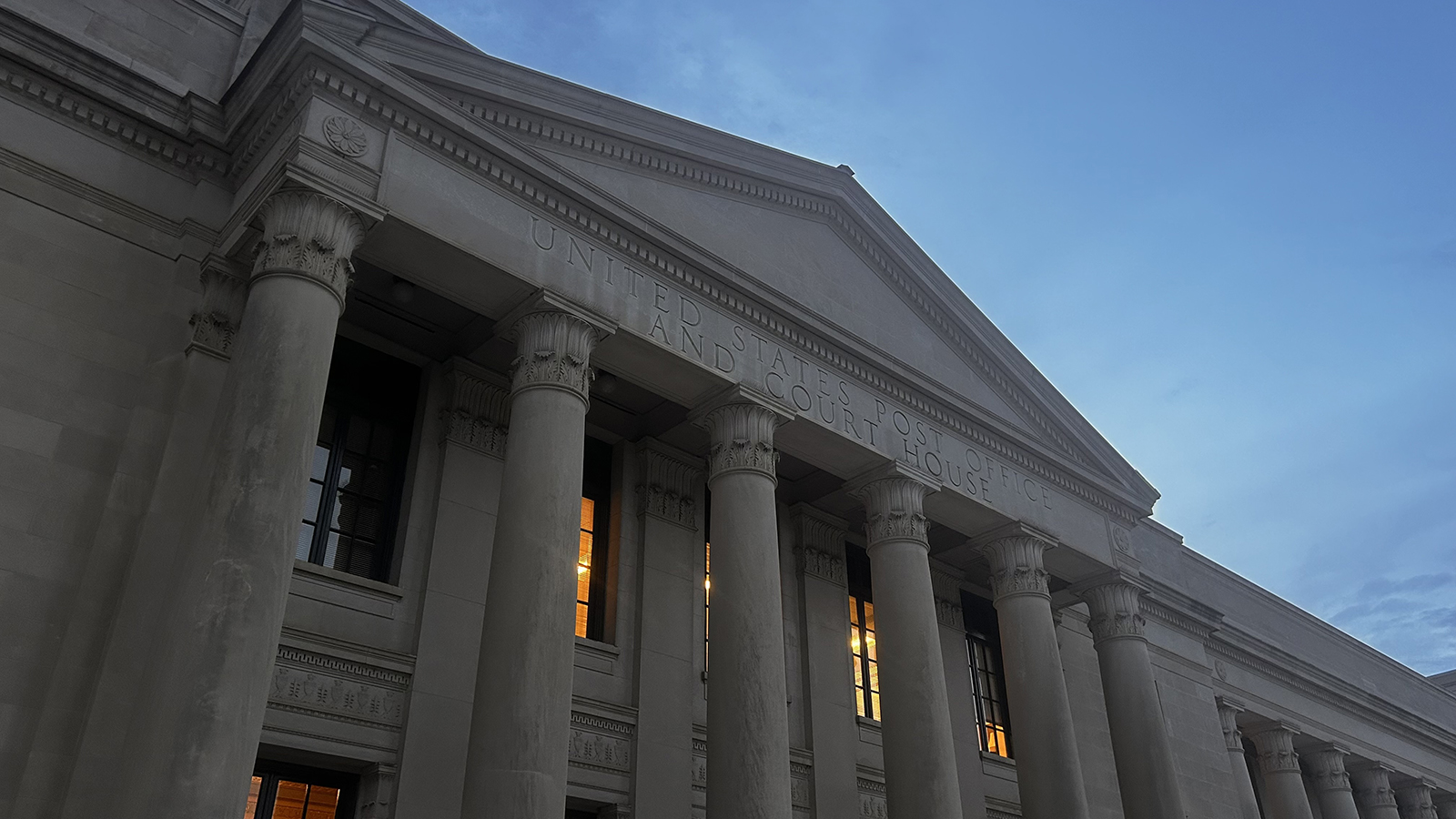
At the conclusion of the fourth day of what has been a slow-moving antitrust trial between 23XI Racing/Front Row Motorsports and NASCAR, Judge Kenneth Bell issued a warning to both the plaintiffs and defendants to pick up the pace of the trial. The Judge emphasized that the trial cannot last an entire three weeks, and that the jury would rightfully revolt if it did.
Related: Live Updates From NASCAR, 23XI, FRM Antitrust Lawsuit
The Judge warned both sides to stop, “beating horses past their death date,” as a lot of the exhibits have been reused through all of the witnesses that have been on the stand so far.
Judge Bell also warned that if witnesses on both sides continue to have a hard time answering direct questions on facts and intent of emails or texts, he may have to step in and be more forceful, as the testimony on these texts, which should take seconds, has been dragging on for 20 minutes or so.
This is the second day that Judge Bell has had to step in at the end of the day. On Wednesday, Judge Bell was incensed that NASCAR’s attorneys had violated two court orders, and he stated that it would not be tolerated going forward.
Additionally, NASCAR’s attorneys indicated that they told Roger Penske that Monday would be a good day for him to testify, and that Monday is the only day next week that the team owner is available to come to court. Jeffrey Kessler said Penske testifying on Monday would disrupt the schedule of the case that 23XI Racing and Front Row Motorsports have built.
As a result, Judge Bell ruled that the Federal Court is simply inconvenient for many, but that Mr. Penske would have to make time on another day to come to testify. Both sides indicated to Judge Bell that they are trimming their list of witnesses in order to shorten the timeline of the trial.
So, what took place on Day 4 of the NASCAR Antitrust trial?
Bob Jenkins Asked About Awkward Charter Sale Attempt to 23XI Racing
NASCAR attorney Lawrence Buterman continued his questioning of Bob Jenkins, which began on Wednesday afternoon, when the court resumed on Thursday at 9 AM ET. Buterman brought into question a topic he approached on Wednesday: Front Row Motorsports’ attempted sale of a Charter/merger with 23XI Racing in 2021.
In an email exchange between Hamlin and Jenkins on September 4, 2021, it’s revealed that Jenkins himself imposed a Friday afternoon deadline on Hamlin for the negotiations for the transaction. Of course, Jenkins and 23XI Racing have been critical of NASCAR’s “take-it-or-leave-it” Charter Agreement offer at 5 PM ET on September 6, 2024.
Hamlin is seen as very frustrated by the deadline in the emails. Buterman questioned Jenkins about how it is okay that he did the same thing he claims was so bad that NASCAR did to him and the other team owners, to which Jenkins said that Hamlin was negotiating for a Charter with other teams at the time, and ultimately landed a Charter from StarCom Racing instead.
As for the deadline, Jenkins explained he had to either renew with Ford for another season or risk losing manufacturer support and his Roush Alliance that had already been in place. He says he did what was best for his race team and moved on, and that he and Hamlin are still friends despite the deadline situation.
But then Buterman asked Jenkins if he was stringing Hamlin along during the negotiations, which Jenkins seemed puzzled by the line of questioning. Then, Buterman revealed internal emails between Jenkins and Jerry Freeze, the General Manager of Front Row Motorsports, from July 2021.
In these emails, Jenkins tells Freeze to let Rick Ware know that Front Row Racing was done trying to sell Charters to 23XI Racing, and that Ware could “Charge whatever he wanted.”
Buterman asked if Jenkins was giving Ware an unfair advantage in his negotiations with 23XI Racing, to which Jenkins essentially said no because Hamlin was talking to other teams as well, and ultimately bought from one of the other teams.
Jenkins had also previously stated that it takes $20 million per year to field a car in the NASCAR Cup Series, but when his team’s financial numbers were revealed, it showed that Front Row Motorsports spent roughly $14 million per car per year. However, Jenkins says he expects that the number was upward of $20 million per car for his team in 2025, but the financial numbers in evidence only went through 2024.
Buterman also put into evidence a letter from Jerry Freeze to Steve Phelps on September 11, 2024 — five days after the “take-it-or-leave-it” offer that NASCAR had given teams — where Freeze delivered Jenkins’ intent to sign the Charter Agreement, pending his legal team reviewing the document.
In the end, Jenkins said he didn’t sign the document as it contained a “side letter” which didn’t address the items he wanted changed in the Charter Agreement. When Buterman questioned why he didn’t give NASCAR specifics on what he wanted at that time, he said that negotiations were over, so there was no reason to give specifics.
NASCAR President Steve O’Donnell Takes the Stand
One of the most-anticipated witnesses of the trial, Steve O’Donnell, took the stand at 10:27 AM ET on Thursday. O’Donnell has had some of the more viral internal text conversations that were distributed online in public record in the lead-up to the trial.
And Jeffrey Kessler definitely pressed O’Donnell on all of those communications. And while most of the internal communications painted what seemed like a pretty certain picture of who and what O’Donnell was frustrated about behind the scenes during the contentious Charter negotiations, he deflected most of them.
One of the most bizarre deflections came in defense of the note that he wrote about Jim France reading the touching letter from Heather Gibbs, who wanted NASCAR to award evergreen, or permanent Charters, to teams.
In the internal message thread at the time, O’Donnell wrote that he was watching France read the letter out loud, and France was swearing every other sentence while reading it.
After reading sections of the letter, Kessler asked what it was about the letter that would possibly make France mad enough to swear?
To which O’Donnell responded, “I wrote that, but he didn’t swear.” Instead, O’Donnell said it was a figure of speech, meaning that France was simply just mad about the letter.
When asked what specifically France was doing or saying that let on that he was mad while reading the letter aloud, and did so to the extent that O’Donnell felt compelled to use “swearing” as the way to describe the behavior, O’Donnell simply said, “I don’t know.”
Kessler then asked, “If you can’t remember, how do you know that he was not swearing?”
Early in the testimony, Kessler asked O’Donnell if Jim France was open to a new model for the Charter System heading into the 2025 Charter negotiations. O’Donnell testified that while Ben Kennedy thought initially that Jim France would be open to it, he ultimately was not.
Kessler took that fact and tied it to O’Donnell’s written frustrations during the Charter negotiations with other NASCAR executives.
After a meeting about an early Charter draft, he called what had been presented a “f—” the team’s offer, which would set the sport back to a “comfortable 1996,” insinuating that it would set the sport backward.
When asked what about it was “f— the teams,” O’Donnell couldn’t, or wouldn’t, recall. When asked if it was Jim France who had upset him in that meeting, O’Donnell said no. When asked if Jim France was the “dictator” he referred to in another internal text thread, O’Donnell said no, and would not name who the dictator was.
While that was the portion of the testimony that will likely get the most clicks on social media, the thing that could end up being the make-or-break moment in the case for NASCAR centered around the sanctioning agreements with tracks, specifically the exclusivity provisions that were enacted by NASCAR beginning with the Charter system in 2016.
As it appeared teams were united in their demands in Charter negotiations in 2022, internal documents show that one of the key strategies to avoid the race teams from creating their own “breakaway” stock car racing series was to “lock up” Speedway Motorsports tracks into multi-year sanctioning agreements, and to add expansive exclusivity provisions, preventing stock car races outside of NASCAR at the venues without written consent of NASCAR.
Interestingly, the provisions extended two years past the sanctioning agreements, which ran from 2023 to 2024.
O’Donnell explained the two-year exclusivity tacked on was only enacted if NASCAR agreed to extend the sanctioning agreement for 2025, but it is curious timing that those added years were put in place at a time when NASCAR wondered if all of the teams would agree to the terms of the Charter Agreement.
However, O’Donnell said they were waiting to see how much money would be in the 2025 media rights agreement before committing to finances for tracks in 2025 and 2026.
Kessler also pressed O’Donnell on the “gold codes” plans, which were a vertical integration strategy posed in internal NASCAR decks, which would have resulted in NASCAR cutting out team owners and just running everything themselves.
O’Donnell claimed that there was never a serious plan to execute the “gold codes” and that it was just briefly drafted as a just-in-case scenario. Kessler said a Google search explained that “gold codes” are what the codes for nuclear weapons are called, and asked if the plan got its name because NASCAR would blow the whole system up if the teams didn’t sign the agreement.
O’Donnell denied this theory.
Other interesting tidbits from O’Donnell’s time being grilled by Kessler included that he has a base salary of $1.2 million per year, plus bonuses. O’Donnell indicated that NASCAR lost $55 million over the three years running the Chicago Street Course event, and lost $6 million running the event in Mexico City in 2025. However, O’Donnell said both events were instrumental in NASCAR landing its five-race media rights agreement with Prime Video.
Kessler was impassioned during the majority of the examination of O’Donnell to the point that O’Donnell asked him to stop yelling during a portion of the questioning.
After Kessler was through, NASCAR’s legal team began its line of questioning of O’Donnell, and things got a lot less rocky for O’Donnell, but NASCAR’s legal team was unable to get very far in its line of questioning for O’Donnell before the end of the day in court. O’Donnell will return to the stand when the court resumes on Friday morning at 9 AM ET.


One Response
So the teams were involved in negotiating the terms of the charter deal. Just like every other year. The teams and nascar reached an agreement. Yet two teams don’t want to sign the agreement, but still want the benefits of being a charter team.