
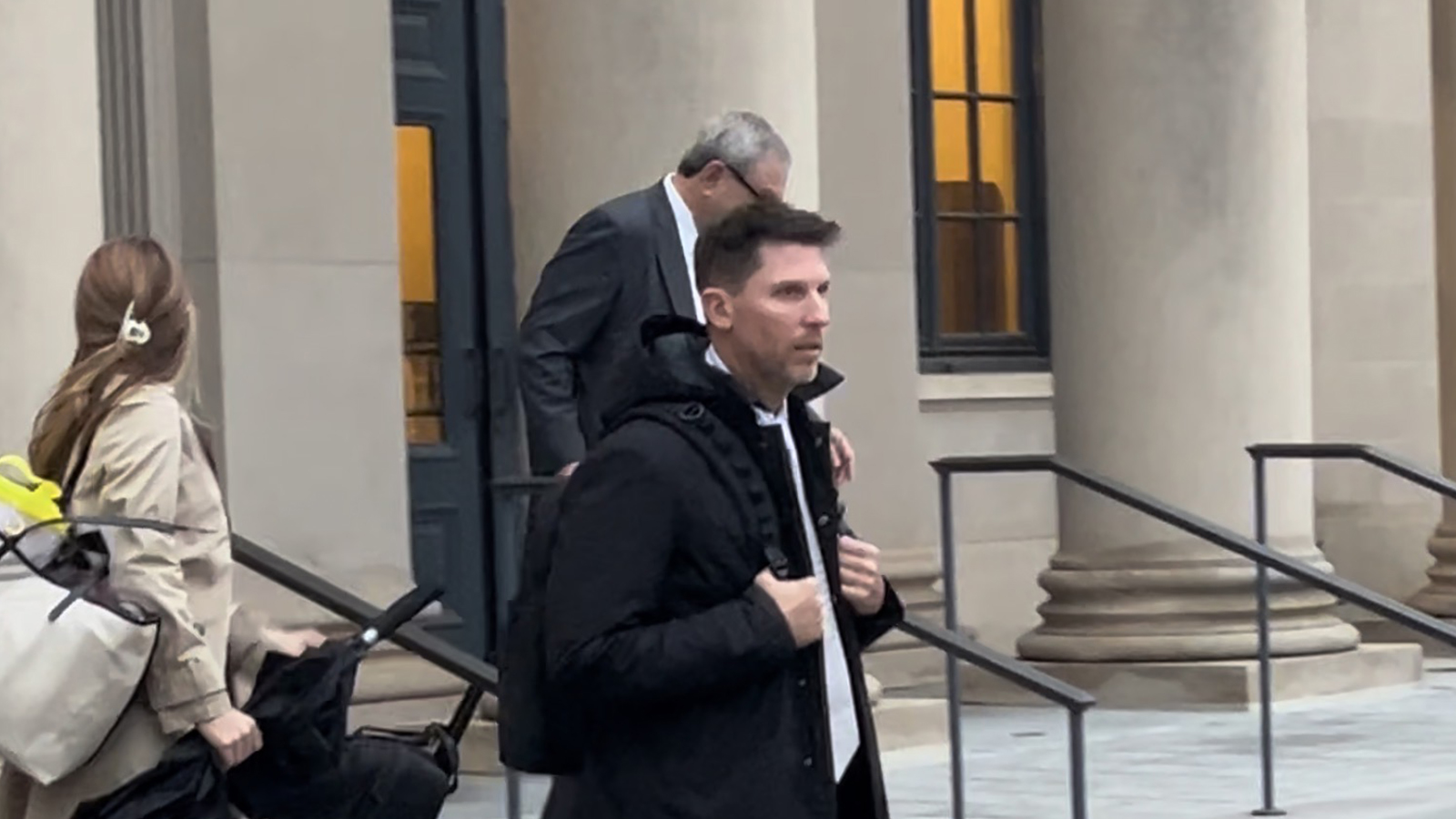
Smoking isn’t one of my vices, but if the remainder of the 23XI Racing/Front Row Motorsports vs NASCAR antitrust trial continues to deliver the fireworks that were on display in the Charles R. Jonas Federal Building in uptown Charlotte, NC, on Tuesday, then I may need to go pick up a carton.
Tuesday’s day in court kicked off with the remainder of Denny Hamlin’s time on the bench as he fielded additional questions from his own legal counsel, which focused on why Hamlin felt it to be a bad decision for the 23XI Racing ownership group to sign NASCAR’s Charter Agreement, which was ultimately signed by 13 of the 15 Charter teams from the 2024 season.
Hamlin, who showed emotion on the stand while thinking about his ill father on Monday, said on Tuesday that while he is fortunate to be one of the few teams in the NASCAR Cup Series that turns a profit, almost every year, he is “one sponsor away” from sliding into the red. Hamlin estimated that 23XI Racing only pulls a 2.2% profit each year.
Part of the reason Hamlin says is that the guaranteed payments from the Charter agreement fall far short of the $20 million per car operating total that the teams and NASCAR concluded in an extensive study that it takes just to get cars to the track each and every week.
Hamlin said when he met with Jim France in a Nashville hotel and had lunch to voice his concerns over the team revenue in the proposed 2025 Charter Agreement, France indicated to Hamlin that he felt the teams spent too much money, and that he’d like to see them cut spending to just $10 million per car.
The 60-time NASCAR Cup Series race-winning driver and co-owner of the 23XI Racing team expressed that he felt “very discouraged” after the meeting with France.
In addition to the $20 million per car, teams have to also pay their drivers, NASCAR Hard Card fees, entry fees, testing expenses, travel expenses, tires, and track wifi, among many other expenses.
Hamlin says that the collective losses from the 36 full-time teams in the NASCAR Cup Series garage have climbed higher each of the past three seasons.
The 2025 Charter Agreement gives teams the guarantee of Charters for the next 14 years, provided they sign the agreement after the first seven years, but the guarantee of the deal going to 14 years long is what Hamlin says would have made signing it a “death sentence” for his team.
While the teams receive a bump-up in television revenue for the first seven years of the agreement, NASCAR is not required to bump up the revenue to the teams during the second seven-year period, even if they experience a major increase in television revenue. NASCAR could raise the amount given to the teams, but they are legally not required to based on the verbiage of the deal.
Hamlin Goes Under Cross-Examination From NASCAR
After taking questions from his legal team, Hamlin was opened up to cross-examination from Lawrence Buterman of the NASCAR antitrust defense team. The cross-examination riled Hamlin up at times, and the legendary driver lost his cool several times through the roughly two and a half hours of scrutiny.
Buterman pressed Hamlin on why he touted the Charter Agreement and Next Gen car specifically as reasons why Michael Jordan should invest in a NASCAR team with him during a 2020 pitch deck that he sent to his now business partner.
Hamlin fired back, “We were told by NASCAR that the Next Gen car would save teams 40%. What was sold to us is not what actually happened.”
When asked why, he said the Next Gen car was a good thing for the sport on an appearance on the Kenny Wallace Podcast in 2024, Hamlin explained, “It was good for the sport. I don’t know about the teams.”
As for the Charter Agreement, Hamlin wasn’t a team owner until after entering business with Jordan at 23XI Racing in 2021, so he wasn’t privy to the details within the Charter Agreement. All he had to go off of were the NASCAR media talking points and some words from other team members he spoke to leading into team ownership.
Hamlin complained that one of the main sticking points for his team not signing the Charter Agreement is that there are no checks and balances in place for teams to vote on whether proposed changes from NASCAR, which would cost the teams additional money, could stop changes that could negatively impact race teams.
The Mexico City race in 2025, Hamlin said, specifically was a burden on the race teams, but he understood NASCAR made quite a profit on that event. This led Buterman to question why Hamlin only spoke positively about the Mexico City event during his Kenny Wallace Podcast appearance.
Hamlin said it’s because if he says anything bad about NASCAR, he gets a lashing from the sanctioning body. He says in addition to being scolded behind closed doors, his team could face more intense scrutiny in inspection at the race track if they say something publicly that NASCAR doesn’t like. As a result, Hamlin has learned to keep his public words about NASCAR to just sunshine and rainbows, and he pushes the talking points that NASCAR provides the drivers and teams to say.
What started out as a $7 million investment to start up the 23XI Racing team, the team’s estimated worth at the conclusion of the 2024 season was $160.2 million. Hamlin and 23XI Racing are seeking more than $200 million in damages from NASCAR in the trial, which NASCAR said would amount to a 900% ROI on 23XI Racing’s initial investments.
During the cross-examination, Buterman also revealed that Hamlin earns $14 million per year as the driver of the No. 11 Joe Gibbs Racing Toyota, and that he and Michael Jordan own the AirSpeed race shop in Huntersville, NC, together, and they lease the property to the 23XI Racing team at a rate of roughly $1 million per year.
According to NASCAR, leasing their own building back to their race team is why 23XI Racing failed to make a profit in 2024, the lone year in which it operated in the red. However, Hamlin says if the team wasn’t paying to race out of the AirSpeed shop, it would have to pay lease at another location, which he felt makes that argument a moot point.
After 23XI Racing opted not to sign the Charter Agreement by the September 6 deadline, the team sent NASCAR a list of eight items that it wanted the sanctioning body to address in the agreement before it could sign.
Buterman says that NASCAR addressed seven of the eight points, to which Hamlin responded back, “Just because you say you addressed it, doesn’t mean it was actually addressed.”
NASCAR also brought up that Hamlin attempted to sell his stake in 23XI Racing during 2023. Hamlin explained that at the time, he didn’t agree with the direction of the race team, but after meeting with his fellow investors, they expressed confidence in his ability to run the team, and everything has been great since.
At the end of the cross-examination, Buterman also revealed that 23XI Racing has a stipulation in Riley Herbst’s contract with the team, which forbids him from racing for another team in any other motorsports event, and that 23XI Racing only uses 22% of its annual revenue to pay its drivers. Buterman asked why it is considered anticompetitive when the teams say NASCAR engages in these tactics, but when the teams do it, it’s business as usual?
“We’re not a monopoly like you,” Hamlin fired back.
Hamlin explained unlike the teams, the drivers have options in the form of other race teams they can race for, while the teams are stuck with only NASCAR to compete in as far as the world of stock car auto racing goes.
NASCAR’s Scott Prime Takes The Stand
The intensity didn’t slow once Hamlin stepped down from the bench. As Scott Prime, the EVP Global Strategy Officer for NASCAR, took the stand, Jeffrey Kessler, the lead attorney for 23XI Racing and Front Row Motorsports, went into full-on attack mode in an effort to present his case that NASCAR has operated unlawfully as a monopoly to harm the race teams since the initial Charter Agreement in 2016.
A key portion of the questioning revolved around NASCAR’s attempts to thwart a potential breakaway stock car racing series, which Prime suggested in internal emails could form if the team owners grew more frustrated with the ongoing Charter negotiations.
Prime, Steve O’Donnell (current NASCAR President) and Steve Phelps (current NASCAR Commissioner) expressed concern in emails that they could experience a similar issue that the PGA Tour encountered after the formation of LIV Golf.
The internal fears with NASCAR only expanded with the formation of the Superstar Racing Experience (SRX), which had attempted to land some race dates at Speedway Motorsports properties, one of the main players in the race track ownership circle in NASCAR.
Prime, who said in court that he was not aware of the IndyCar/CART split in the 1990s, is seen in emails outlining steps to snuff out the formation of a rival stock car racing league.
Among the steps to avoid the formation of a breakaway stock car racing series, Prime felt NASCAR should strengthen its relationship with Speedway Motorsports, as he felt a breakaway series would need to utilize their tracks if they were to put on a Cup-level style series.
Among the proposed options in Prime’s briefings were to either secure multi-year agreements with Speedway Motorsports to lock in their tracks and bake in exclusivity agreements, which would prevent the tracks from hosting any competing “stock car” racing series. NASCAR also considered buying Speedway Motorsports out, which would have given the sanctioning body nearly every track on the NASCAR Cup Series circuit within its portfolio of racing facilities.
In the end, NASCAR, which had previously gone to one-year sanctioning agreements with Speedway Motorsports tracks in an effort to encourage Speedway Motorsports to reinvest in its facilities each year, opted to expand to two-year agreements for 2023 and 2024, but NASCAR also included exclusivity agreements, which extend two years past the two-year sanctioning agreement, shown in the 2023-2024 agreement for Las Vegas Motor Speedway.
Kessler alleges that this action stopped any attempt that could have been made for another stock car racing series to form in the United States.
Kessler then referenced an interesting email from Prime to NASCAR colleague Susan Shandel, where Prime expressed, “We’re getting robbed by the tracks.”
Prime was blown away when he found out IndyCar actually earns payments from race tracks that it races at, while NASCAR has to pay $7 million (or more) to each track out of its media rights agreement to race at their facilities.
Kessler asked Prime if he knew why NASCAR had to pay the tracks, while IndyCar instead got paid by the tracks and jabbed him by saying, “Because you’re paying for exclusivity.”
To which Prime expressed he was unaware of that fact.
Kessler also brought to the attention of the jury the shares of the NASCAR Broadcast Revenue deal pie. NASCAR claims that it only receives a 10% portion of the TV rights money, while the remainder of that revenue is divided between the race teams and the race tracks; however, Kessler explained that the figure is disingenuous, as NASCAR owns the majority of the race tracks that are raced in the NASCAR Cup Series.
With NASCAR taking the previously publicly traded International Speedway Corporation private and rolling it under the NASCAR umbrella, that is now a part of NASCAR’s yearly revenue. When that is factored in, Kessler says NASCAR takes home the lion’s share of the revenue in the sport.
Toward the end of the day, Kessler focused on internal conversations between Prime, Phelps, and O’Donnell during the Charter negotiations, where all three executives seemingly grew increasingly frustrated with Jim France and the NASCAR board and their stance during the negotiations.
Prime admitted to Kessler that he, along with Phelps and O’Donnell, felt it would be more beneficial to NASCAR to make some concessions to the teams in order to help grow the sport with healthier race teams.
At the beginning of the Charter negotiations in 2022, a four-member Team Principal Council expressed to NASCAR what they wanted for the 2025 Charter Agreement. The teams collectively wanted $722 in annual Charter Payments, which would cover the $20 million per car figure that they and NASCAR each concluded was necessary to run a NASCAR Cup Series team in a study.
The teams didn’t end up with $722 million. Instead, they came up roughly $300 million shy of that number in the 2025 Charter Agreement.
The teams were also seeking 33% of new revenue sources within NASCAR, which utilized the team’s own intellectual property. Not only were the teams not granted this, but NASCAR actually stripped the teams of their intellectual property in the new agreement.
Additionally, the teams wanted 33% of future media revenue increases and permanent charters. Neither of those asks was granted with the 2025 Charter agreement.
Prime said the one concession NASCAR made to the teams along the way was that they put in a provision that if the current Charter teams allow their Charters to expire by not signing the agreement, NASCAR couldn’t offer the Charters to new team owners at different terms than the current NASCAR team owners have had.
Kessler alleged that the final Charter Payment amount in the 2025 Charter Agreement was actually lower than the figure initially offered by NASCAR at the beginning of the negotiations, which Prime said he couldn’t remember if that was the case. As time for the day was running short, Kessler warned Prime that they would approach that on Wednesday, as Prime’s testimony is set to continue at 9 AM ET.
Two days into the biggest trial in the history of NASCAR, and the action has been fierce. In addition to the remainder of Prime’s testimony, we’ll see who is called to the stand to testify on Wednesday.


One Response
I much appreciate your in-depth reporting. Keep up the good work!