

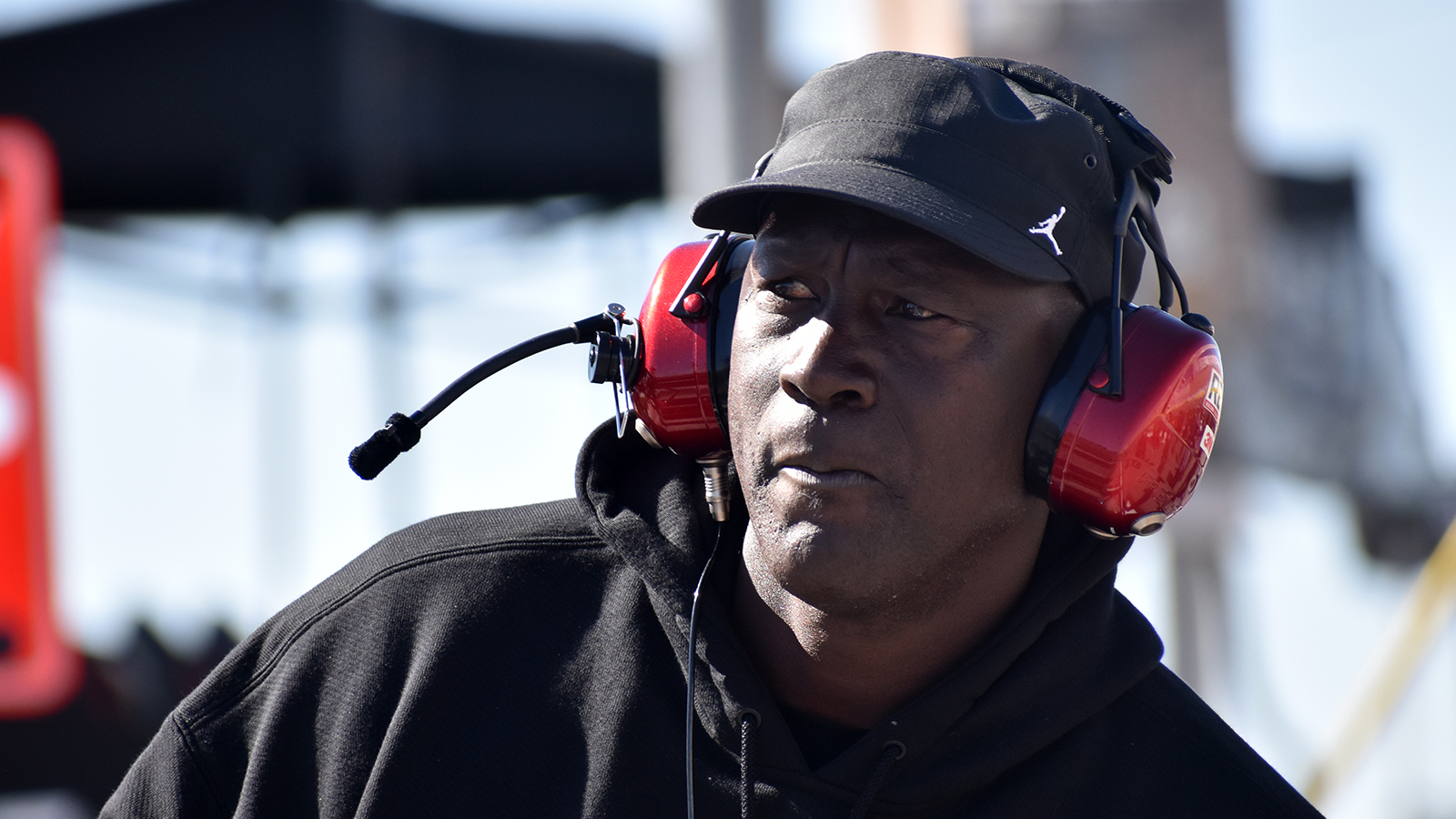
As expected, following Judge Kenneth Bell’s warning to pick up the pace of the trial, day 5 of the NASCAR antitrust lawsuit saw Steve O’Donnell, Heather Gibbs, Michael Jordan, and Jonathan Marshall all take the stand.
The day ended with Marshall still on the stand, and he’s in the midst of a heated line of questioning from NASCAR attorney Lawrence Buterman, who earlier in the day was gushing over the chance to cross-examine Jordan, one of the greatest athletes of all time.
Steve O’Donnell Wraps Up His Testimony
At the conclusion of his testimony, which stretched roughly six hours over the last two days, O’Donnell explained that NASCAR proposed a cost cap and cost floor for race teams during the 2025 Charter negotiations, but the NASCAR President said it was a mixed reaction from teams on the idea, so it was ultimately nixed.
The NASCAR executive also told a story about a Charter negotiating meeting, where Curtis Polk of 23XI Racing was aggressive and threatened to kick O’Donnell out of his own meeting. He said that prior to that, the meetings with team representatives were more respectful. O’Donnell said it was the most difficult meeting he’s had with an individual.
When pressed on Polk’s level of respect, Kessler reminded O’Donnell of how NASCAR executives were showing a lack of respect for team owners such as Richard Childress and Heather Gibbs behind closed doors in the communications that were made available in discovery.
As far as the threat of SRX, O’Donnell said that he felt SRX officially became a competing stock car series when he saw Chase Elliott compete in the series with the “stylized” No. 9 that he uses in NASCAR. However, it should be noted that Elliott did not use the “stylized” Hendrick Motorsports font in his SRX starts.
In reference to the allegations from the plaintiffs that NASCAR doesn’t award enough of its broadcast television money to the race teams, O’Donnell explained that IndyCar teams, which cost $8-10 million per year to field a car, only receive 25% of the cost of those cars in their portion of the IndyCar media rights agreement.
However, when Jeffrey Kessler had a chance to re-call O’Donnell, he noted that with IndyCar’s broadcast agreement only being worth $8 million per year that IndyCar actually pays its teams 200% of its broadcast deal revenue, compared to the 45% that NASCAR agreed to pay its teams with the 2025 Charter agreement.
Kessler questioned why the Charters couldn’t be permanent with negotiable economic terms, as is the case with franchises in every other sport. O’Donnell responded that NASCAR didn’t award teams permanent Charters because there are too many intangibles, including what car teams will be required to use.
He then admitted that the board rejected the language involving permanent charters.
Another interesting note from O’Donnell’s testimony was that he said the Andretti IndyCar team had inquired about NASCAR Charters at one point with manufacturer Honda.
Heather Gibbs Potentially the Star Witness of the Trial
While many will focus on Michael Jordan’s testimony, due to his celebrity status, one of the most impactful witness testimonies in this trial, so far, came from Heather Gibbs, the co-owner of Joe Gibbs Racing, on Friday.
Gibbs began her stint on the stand by recalling the story of how she became a co-owner of Joe Gibbs Racing, which resulted in a bit of emotion as she publicly talked about the tragic and sudden passing of her husband, Coy Gibbs, for the first time.
She also joked that while Joe Gibbs Racing is a five-time NASCAR Cup Series winning team, they should have six championships, as Denny Hamlin had the lead with two laps to go before a caution came out in the Championship Race at Phoenix in April. That jab led to a section of laughs within the courtroom.
Gibbs was asked about her heartfelt letter, about why Permanent Charters were important to her and her team, which she sent to NASCAR during the Charter negotiations. She says she sent the letter because she was bothered by Steve Phelps telling team owners that they were “reckless” with their spending.
For Gibbs, who says his father-in-law, Coach Joe Gibbs, felt the same way, permanent charters were one of the most important items that they were negotiating for. She said the same was true for the entire group of race teams.
She said that after sending her letter to Jim France, Lesa France Kennedy, Ben Kennedy, and Steve Phelps that she got a response from Lesa France, which indicated that the NASCAR board was receptive to the letter, and she felt her friendship with the France family would allow them to at least consider her words in the letter.
However, an internal conversation between NASCAR executives, which was shown during the testimony of Scott Prime and Steve O’Donnell, painted a picture that Jim France was not pleased by the letter. O’Donnell messaged his fellow executives that he was watching France read the letter aloud and that he was swearing every other sentence.
In his testimony, O’Donnell said that France wasn’t actually swearing and that it was a figure of speech for him being angry.
Gibbs explained that she still feels permanent Charters are vital for race teams in NASCAR, as they need to know the asset cannot be taken away. She said Joe Gibbs Racing ultimately signed the Charter agreement simply because they have too many employees who depend on the race team being in operation.
But she had a consistent story about how the “take it or leave it” offer came from NASCAR on Friday, September 6, at 5 PM ET, from what others who have testified about it have said.
She also said that she believes that the way the 2025 Charter agreement is laid out, it opens teams up to another potential “take it or leave it” situation in seven years.
Michael Jordan Explains Why He Took a Stand Against NASCAR
The entire courtroom was seemingly starstruck by NBA legend and 23XI Racing co-owner Michael Jordan taking the stand on Friday. The courtroom was at full capacity, and there were two overflow rooms in the courthouse for those covering the testimony.
Jordan started off his testimony by explaining the origin of his NASCAR fandom. Jordan says he became a fan of Richard Petty while attending races with his father at the age of 11 or 12.
James Jordan, his father, was friends with longtime NASCAR team owner Hoss Ellington, who would feed information to the Jordan family about how the season was unfolding when the races were not on television.
Jordan said that his family would routinely travel 10 hours by car to Talladega Superspeedway to attend races there in what he called family vacations.
As a team owner for 23XI Racing, Jordan says he is not involved in the day-to-day operations of the race team. He’s more of a fan who backs the team financially, and he does everything he can to help the team land sponsorship, and he attends 10-12 races per year. Jordan says when he’s not at the track, he watches the race on TV.
“I never miss a race,” he said.
Jordan said he has invested $35-40 million into the race team, and that he was the one who purchased the Stewart-Haas Racing Charter for $28 million in 2024 as the Charter negotiations were ongoing. Jordan said he chose to purchase the Charter after a conversation with Denny Hamlin, where they both concluded that having three cars would increase their chances of winning a championship.
As for why he didn’t sign the 2025 Charter agreement, Jordan says it simply wasn’t a viable equity decision, and the contract had a provision where he would be unable to sue NASCAR, which he felt wasn’t appropriate. The straw that broke the camel’s back was the ultimatum that NASCAR gave teams on September 6 to sign or lose their Charters.
Jordan was frustrated that permanent Charters, which he says team owners have wanted since before he was an owner, weren’t ever seriously considered by NASCAR, nor were any of the four pillars posed by the race teams (permanent Charters, governance, ancillary revenue, and percentage of any new revenue).
But Jordan feels permanent Charters are necessary for many reasons, including giving the teams some leverage in negotiations. Currently, he feels it’s a one-sided fight between the sanctioning body and the teams.
The team owner and Hall of Fame basketball player says that he didn’t enter into the lawsuit for his own needs, as his team is one of the few that turns a profit most years. Instead, he did it for the other team owners, who he says have been brow-beaten in meetings with NASCAR for years. He felt someone needed to take a stand.
As for what is broken about NASCAR, Jordan feels the sport, which claims it wants to be a partnership of all stakeholders, isn’t a partnership at all. He said when he was in the NBA, they had a partnership with teams and players. NASCAR is different; it’s a private entity and contractors.
Jordan feels that if both sides, teams and NASCAR, can ever find a way to meet in the middle for a true partnership, they will be able to grow the sport.
In his cross-examination, Jordan did say that when he became a team owner in 2021 that NASCAR and the France family were welcoming, and he did give the France family credit for building the sport of NASCAR. At the end of the cross-examination, NASCAR attorney Lawrence Buterman thanked Michael Jordan for making his kid think he’s cool today. Jordan joked that he didn’t see him wearing his Jordan shoes today. Buterman told him he would be wearing them later.
Jonathan Marshall, the Executive Director of the Race Team Alliance, was the next witness called to the stand. While he laid out a lot of details about the finances of race teams and the inner workings of revenue models in other sports compared to NASCAR, the defense is currently battling his recollection of events, and the legitimacy of the numbers in his studies.
However, Buterman explained to Judge Bell that he has roughly 45 minutes of questioning left for Marshall, which will have to pick back up on Monday when court resumes at 9 AM ET.
At the end of the day, Judge Bell explained to the jury that the speed of the trial picked up considerably on Friday, following his instructions, while the jury was dismissed the day prior. He also let the jury know that while his goal is still to conclude the trial by next Friday that he can’t promise that timeline with how slow things dragged out in the opening days of the trial.
As the court was adjourned, outside, there was a NASCAR fan protesting with a sign that read “NASCAR, your fans deserve better” on one side, and “Our sport used to be great” on the other side.
A #NASCAR fan is protesting outside the courthouse. pic.twitter.com/zIice3Un6C
— Toby Christie (@Toby_Christie) December 5, 2025
As Michael Jordan emerged from the courthouse, he was welcomed by a group of fans and a slew of media that had otherwise not covered the trial.



One Response
NASCAR should go back to the old ways. It was better.