
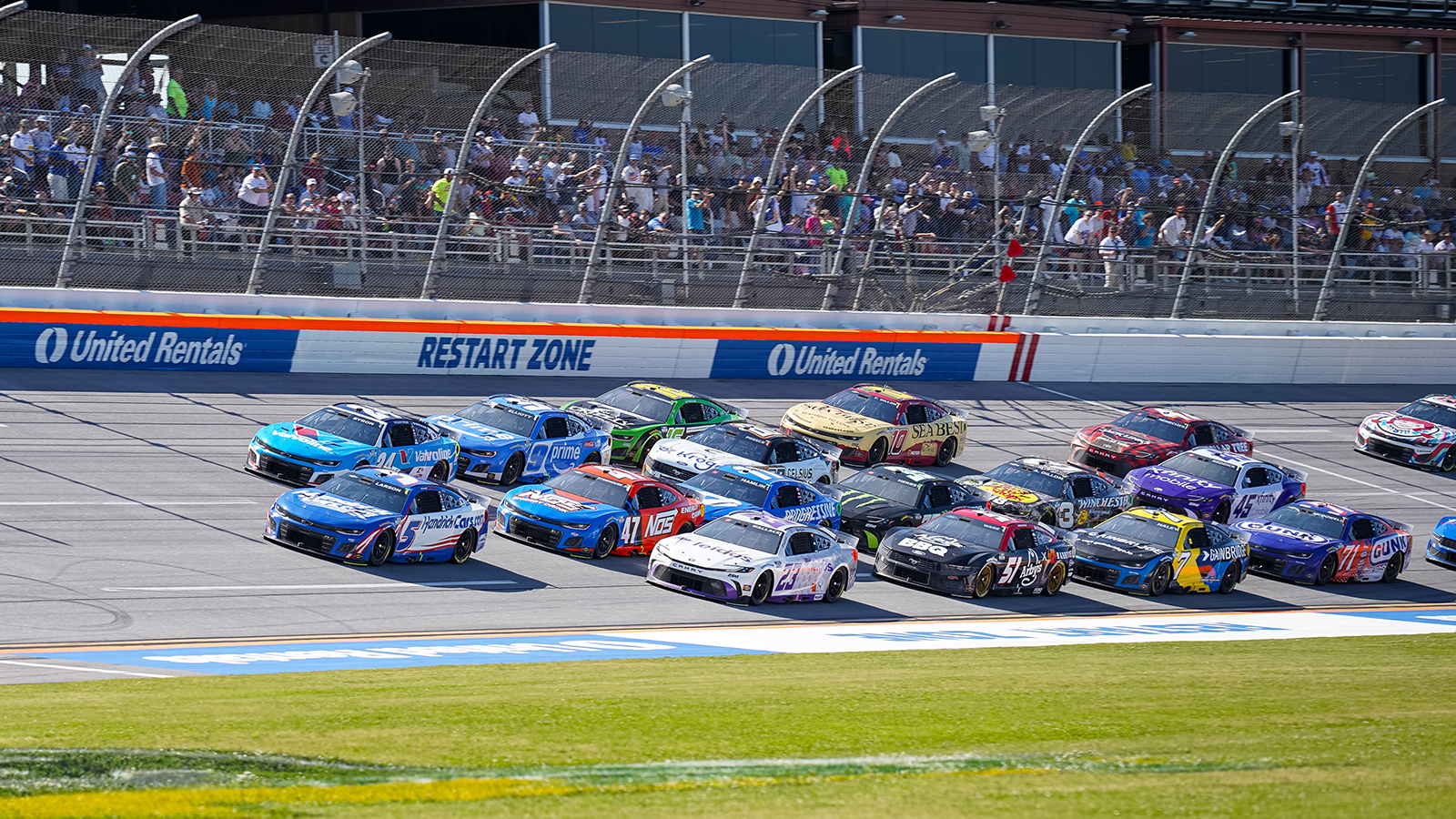
It’s official. After months of speculation, NASCAR formally announced the latest format that the sanctioning body will utilize to award champions in the NASCAR National Series ranks for the foreseeable future in a press conference at the NASCAR Production Facility in Concord, NC, on Monday afternoon. Essentially, we’re going back in time to 2013 with a format that will evoke memories of the classic “Chase for the Cup” format.
To open the press conference, which also included NASCAR Hall of Famers Dale Earnhardt Jr., Mark Martin, and current NASCAR drivers Chase Elliott, Ryan Blaney, and Chase Briscoe, NASCAR President Steve O’Donnell explained the return to the format to open the event.
“Not lost on us that throughout what we’ve seen with the current format, there were times when a driver could win and maybe take a couple races because he had that win in the bank. That’s not something we wanted,” O’Donnell stated. “We wanted every race to matter. So both of those needed to be front and center. Then we also wanted our fans to know that we’re listening and our industry to know that we’re listening. With that, where we’ve landed is candidly the Chase is back. We are going back to a format where the Cup side, the first 26 races, will be based on points system, and the final 10 races will make up the Chase.”
For those familiar, the Chase for the Cup format was used, with tweaks, from 2004 to 2013.
In the 2026 NASCAR Cup Series, there will be one points reset, which will be done to initially set the field of 16 drivers, who will compete for the Bill France Cup over a 10-race cumulative points battle for the championship. The previous Playoff format, used from 2014 through the 2025 season, featured three elimination rounds that consisted of three races, and one final race for the final four drivers to battle for the championship in a winner-take-all event.
Under the new format, the 16 drivers who will compete for the title in the new iteration of the Playoffs will be determined by the regular-season championship standings.
The “Win and you’re in” aspect of the prior iteration of the Playoffs has been removed in favor of awarding additional points to race winners. In 2026, race winners will receive 55 championship points, up from the previous total of 40. The remainder of the field will collect the same 35-to-1 point totals from the previous 2025 points format.
The top-seed of the new format of the Playoffs (the driver, who wins the regular-season championship) will head into the 10-race championship fight with 2,100 championship points and will hold a 25-point lead over second-place in the championship standings, which will have their point total set at 2,075. The third-place seed will enter the Playoffs 10 points behind second-place at 2,065 points, while every position below third-place will sit five points lower in the standings than the position ranked ahead of it.
This essentially means winning will remain an important aspect of drivers looking to be named the series champion, but a one-off win before the start of the Playoffs will no longer erase a mediocre season.
Throughout the process of deciding the new NASCAR Cup Series championship format, Mark Martin was the loudest voice in support of the full-season championship format. While NASCAR ultimately didn’t decide on the full-season format that Martin pitched, the return to the 10-race Chase was quite a concession from NASCAR, one that Martin feels is a fair compromise for everyone.
“The fans were yelling at me, ‘We want full-season points.’ So I yelled even louder and almost got thrown out, as Steve said,” Martin quipped. “I think that this is the most perfect compromise that you could ever ask for. It’s going to require our 2026 champion to be lightning fast and incredibly consistent, and that’s what we can all get behind.”
Martin, who loves the sport, hopes Monday’s announcement can convince fans, who maybe fell out of love with NASCAR in recent years, to come back into the fold.
“I would just appeal to the race fans, all the race fans, but especially the classic fans who say to me, I don’t watch anymore. I say we need you. Come on back. We’re headed in the right direction. Come back and join with us, and we’ll keep making progress,” Martin explained.
Dale Earnhardt Jr., who also favored the full-season format, contends that this compromise is the closest option NASCAR could choose without going to the full-season format.
“I was really excited to hear the news that we were getting a little closer to a full 36-race format. This is as close in my opinion that you can get without going all the way,” Earnhardt said.
Earnhardt also feels the elimination of “Playoff Points” and multiple cutoff rounds with points resets will make the championship battle easier for fans to understand and follow.
2020 NASCAR Cup Series champion Chase Elliott agrees that the 10-race Chase is a great compromise for those, who enjoy Playoffs, and others, who enjoy a full-season format.
“A couple things come to my mind, first and foremost, to Steve’s point, willing to listen, right? Not only to Mark and Dale and even guys like myself and Ryan, who I think have kind of screamed at some of these things over the course of time of just wanting it to be better. I think we all want it to be better because, to Dale’s point, we are fans of this sport,” Elliott said. “I grew up a fan. I watched that video. A lot of those years of Jimmie dominating and the championship of Tony and Carl, all during the Chase, were incredible runs. I think we oftentimes forget how good we had it through all those years of the Chase format. I think it is a really nice compromise. I think getting a full season was going to be a pretty big challenge, and I’m not sure there’s really a better place to land than a true 10-race Chase, really similar to what we had through those years of the epic battles that we saw.”
Ryan Blaney, the 2023 NASCAR Cup Series champion, feels the change will bring a more pure-racing feel to NASCAR, and for that, he’s happy, as that’s what he grew up following as a child.
“I sit back, and I look at this new format, and sometimes we all get grief about over-aggressiveness and things like that, and sometimes you get put in these situations where it’s a win and move on type scenario. I think it’s going to clean up a lot of the racing side of it and get back to the purity side of it, to where it is a little bit more of not brash, a little bit more of the beautiful art form that I grew up loving,” Blaney said. “I am a huge fan of it, like Chase said, and all these guys said. I appreciate NASCAR for listening. I appreciate all these guys, Mark and Dale, for being big voices for us. It’s just fun to be a part of it. I look forward to next year, and consistency is going to be a massive part of it.”
In addition to the NASCAR Cup Series, the NASCAR O’Reilly Auto Parts Series (formerly Xfinity Series) and NASCAR Craftsman Truck Series will adopt the same format for the 2026 season, albeit with a different number of races in the “Chase” for the championship, and with a different number of drivers, who will be eligible to win the title.
The O’Reilly Auto Parts Series will battle it out in a 12-driver, eight-race “chase”, while the Craftsman Truck Series will battle it out in a 10-driver, seven-race “chase” for the championship.