

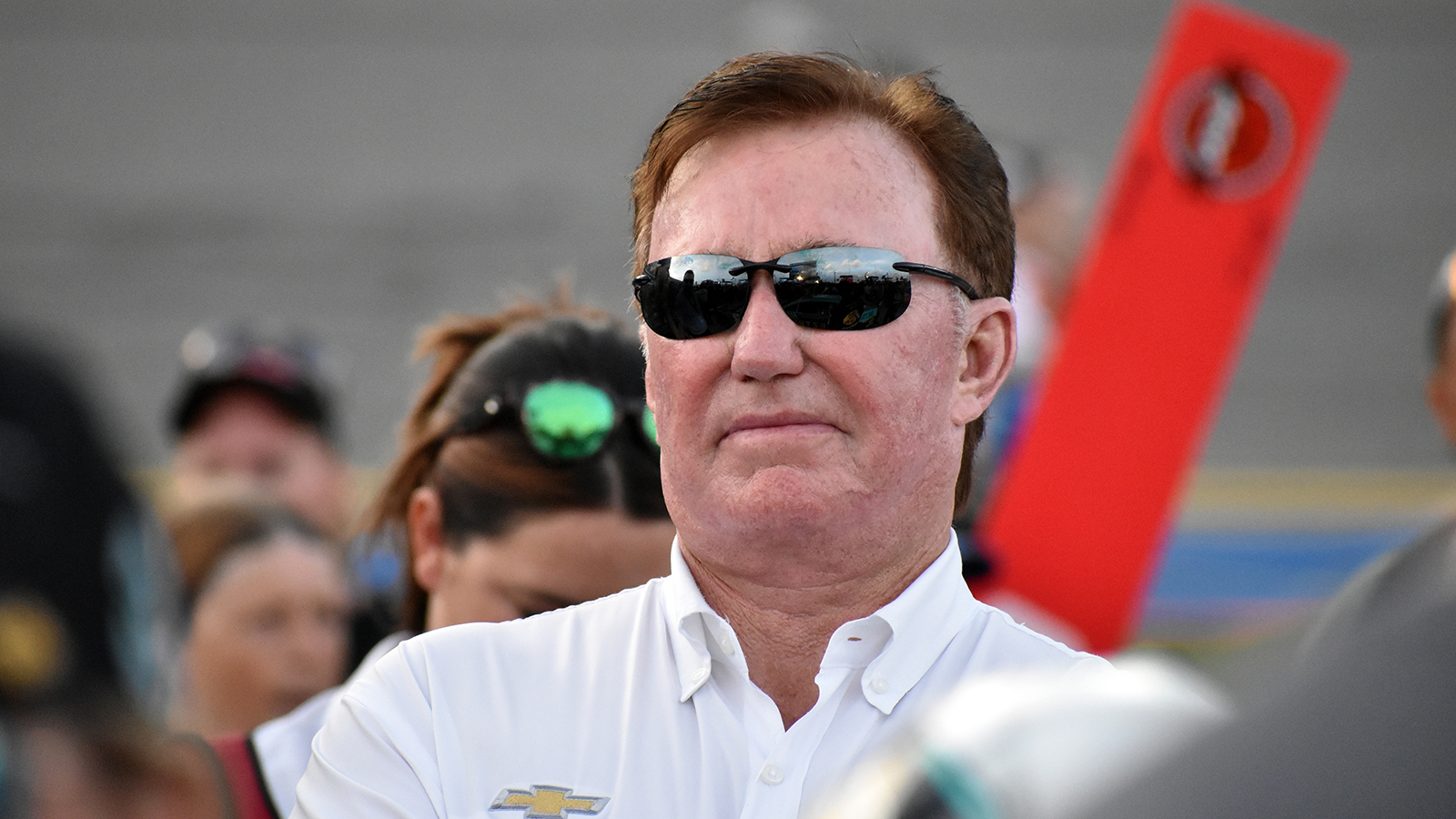
When ranking people you likely don’t want to make mad in the NASCAR world, Richard Childress has to be near the top of the list. The former driver turned legendary NASCAR Cup Series team owner has had a knack for speaking his mind and for using his fists if needed over the years.
Tuesday, Childress was among the witnesses who took the stand for their testimony in the ongoing antitrust trial that has pitted race teams 23XI Racing and Front Row Motorsports against NASCAR.
Childress delivered an impactful testimony, which ultimately furthered the case for the plaintiffs, but it was part of his cross-examination that ended up being the talk of the town.
While seeking to impeach Childress, who said that team ownership in the NASCAR Cup Series wasn’t profitable, NASCAR attorney Christopher Yates began to recite from a document that had not been made available in discovery. Additionally, Childress claimed the document is protected under a non-disclosure agreement.
After Childress claimed team ownership wasn’t a profitable business venture with the state of the 2025 Charter Agreement, Yates asked Childress, “Who is Bobby Hillin Jr.?”
Childress responded, “A racer.”
Yates responded, “And a pretty good businessman, correct?”
To which Childress said he wasn’t sure how good of a businessman Hillin was, but yes.
This laid the foundation for Yates to reveal that Childress, who it was also revealed holds a 60% stake of ownership in Richard Childress Racing (Chartwell Investments owns the other 40%), was in talks with an investment group led by Hillin to sell a portion of the ownership of Richard Childress Racing.
Childress says Chartwell has been looking to get out of its ownership role in the team for 4-to-5 years, and that Childress is also open to selling a portion of his stake.
In the end, Childress said he terminated the talks as Hillin’s group was too “pie in the sky,” but he questioned how Yates obtained the document, as it was protected with an NDA. This was a question that the plaintiff’s attorneys asked at the end of the day’s proceedings, to which Judge Kenneth Bell agreed that the admission of evidence that had not been offered into discovery and that had been held under an NDA, and was used to reference the finances of Childress’ non-Cup Series financials, was improper.
Judge Bell instructed both sides to come up with a resolution to the situation or the court would step in.
Aside from the interesting exchange about Hillin, Childress testified about his thoughts during the 2025 Charter agreement negotiations, and his recollection of events mirrored that of Heather Gibbs, a co-owner of Joe Gibbs Racing, who testified last week.
Childress said he felt that he had no other option but to sign the agreement, which was sent to him at 5:00 PM ET on September 6, 2024, with a call from Steve Phelps telling him to sign or he’d lose his Charter.
Childress explained to the court that if he had the financial means to race without his charter, he would have chosen not to sign the agreement. However, Childress says RCR is a blue-collar team that does what it has to do.
Yates began his cross-examination by showing an email from Richard Childress to Jim France, where Childress outlined the four pillars that he felt RCR needed to be addressed with the 2025 Charter agreement.
As Yates read the opening portion of the statement, where Childress states that Charters have been a good thing for teams, he attempted to move on, but Childress, who is emphatic that he wrote the email himself wouldn’t let Yates press on without allowing him to read the rest of the email, where Childress explained to France that the biggest item for him was the permanency of Charters, as he feels that would drive equity value in the teams.
Childress, who is an owner of the Carolina Cowboys team in PBR, explained that the PBR has permanent franchises, and the teams have seen exponential growth in equity. He says that while NASCAR teams didn’t pay for their Charters in 2016 that he and other owners offered to the France family to purchase the Charters in order to become equity partners in NASCAR, as is customary in other sports.
The France family, Childress claims, turned that offer down and awarded Charters cost-free in 2016. However, Childress claims he and other owners “Paid their life” for their Charters.
When pressed by Yates on whether the Charter system has driven long-term equity to race teams, Childress admitted it had. He said prior to the Charter agreement, teams were worth pennies on the dollar. However, Childress continued to contend that permanent Charters would further drive equity value higher for teams, which echoed the expert testimony from earlier in the day by Professor Edward A. Snyder.
For the most part, Childress was composed on the stand, and even shared a bit of emotion with the jury as he told the story about how he went from selling peanuts and popcorn at Bowman Gray Stadium as a youth to starting his own driving career with the purchase of a $20 1947 Plymouth.
Childress got choked up when talking about the death of his friend, and longtime driver Dale Earnhardt. The open set the tone for the rest of Childress’ testimony, which again furthered the narrative delivered by Heather Gibbs last week that the teams signed the Charter Agreement, but did so because they felt they were left without an option. They had to either sign it, or lose their Charters. And unlike Michael Jordan, they didn’t feel they were equipped to fight the legal fight against NASCAR.
NASCAR’s primary argument is that only the two teams suing them were unhappy about the 2025 Charter agreement, and that the other 13 teams willingly signed. Now, it seems that some of those teams, including Richard Childress Racing and Joe Gibbs Racing, weren’t as willing as previously described.
Jim France Admits He Has Never Supported Permanent Charters
NASCAR Chairman Jim France took the stand at the end of Tuesday, and he was grilled by Jeffrey Kessler. However, for the most part, France used the “I don’t know” or “I don’t recall” answer for a bulk of the questions posed to him.
France, who revealed his compensation as NASCAR’s Chairman is $3.5 million per year, was asked if Lesa France Kennedy is also an employee of NASCAR. France responded that he believed she was, but when asked about her job title and compensation, he indicated that he didn’t know.
While France didn’t agree with how Kessler posed the question, he did agree that it was he who said no to permanent charters to the teams. And France indicated that his stance on permanent or “evergreen” charters never changed throughout the negotiation process for the 2025 Charter agreement, which spanned more than two years.
A big point of NASCAR’s defense has been that the bulk of NASCAR team owners had additional revenue as their main point of negotiation in the Charter talks, but Kessler showed France personal emails from Rick Hendrick, Joe Gibbs, Roger Penske, and Jack Roush, in which all four team owners separately indicated that permanent Charters were their top ask in the negotiations as they felt they were imperative for the stabilization of the business model of team ownership.
France acknowledged the emails, but again, didn’t waver in his disdain for permanent Charters.
Another odd moment of France’s testimony came when he was asked about Steve O’Donnell’s internal NASCAR emails that state he was watching France read Heather Gibbs’ letter requesting permanent Charters aloud, and that France was “swearing every other sentence.” O’Donnell later testified that France wasn’t swearing, but that it was a figure of speech to indicate France was angry while reading the letter.
France said he didn’t recall this, which led Kessler to read the entire letter back to France, and paragraph by paragraph, he asked France if this was something that would anger him, to which France would say, “No.”
This led Kessler to ask if O’Donnell was lying in the email and his testimony, to which France said he wasn’t testifying that O’Donnell was lying; he just didn’t recall being angry, and that he doesn’t feel like reading the letter aloud is something he would have done.
Steve Phelps Encounters Intense Questioning From Kessler
As Steve Phelps took the stand on Tuesday, he encountered intense scrutiny from Jeffrey Kessler.
Kessler had Phelps reveal that he inherited a large raise when he was promoted from NASCAR President to NASCAR Commissioner in March 2025. Phelps went from a base salary of $1.6 million with up to $3.1 million in bonuses to $2.5 million with up to $2.5 million in bonuses.
Kessler pointed out that Phelps explained that his duties and responsibilities had not changed with the promotion, and was then asked how he got the raise, despite that fact.
Phelps justified the increase after his role in the 2025 Charter negotiations, as well as NASCAR’s new seven-year media rights agreement, which kicked off in 2025. Phelps also explained that he had been moved into the role of Commissioner 18 months prior, but the board didn’t officially announce it because it wouldn’t be proper to do so during the negotiations.
Kessler opened up the financial information for NASCAR, which showed that NASCAR had $1.7 billion in revenues during 2024, and it ended that year with $102 million in net income. The year before, NASCAR had $536 million in net income, but Phelps indicated that was due to the sale of land located at Auto Club Speedway.
Phelps then noted that the money was used to pay down debt incurred by NASCAR when it purchased ISC. Kessler noted that using that money to pay the debt down, instead of sharing with other stakeholders, directly benefited the France family. Phelps hypothesized that it helped the entire industry.
Kessler also used an email to Phelps from Brent Dewar, which showed that NASCAR was “surprised and disappointed” in the RTA for the organization planning out a stock car event in 2015. Phelps claimed not to remember that email.
That event never came to fruition, and Phelps explained that he also wasn’t sure why.
Phelps was then asked about the NASCAR track sanctioning agreements leading into the 2016 Charter Agreement, which included exclusivity deals that put up roadblocks to potential competing stock car series.
Phelps also didn’t recall emails regarding this from Dewar, to which Kessler asked if part of Phelps’ job description at the time was to read his boss’s emails? Phelps said, of course, he read Dewar’s emails when he served under him.
The topic of SRX came up, and Phelps admitted that he became concerned about SRX from day 1 of the series being formed, which was different than when Steve O’Donnell described that he personally was worried about SRX. Phelps corroborated what O’Donnell testified to, which was that NBC executive Sam Flood reached out after Chase Elliott won the SRX event at Nashville Fairgrounds Speedway. Flood raised an issue with a NASCAR driver racing with a stylized No. 9 (Elliott ran the No. 94 in that race, which was not the HMS stylized No. 9 font), with NAPA sponsorship and colors.
After Justin Marks and Denny Hamlin began competing in the series, Phelps texted Scott Prime and Steve O’Donnell that it was time to, “Put a knife in this trash series.”
Kessler asked if that meant he intended to kill SRX?
Phelps said he was upset with SRX seemingly stealing some of NASCAR’s look and feel, but said that NASCAR’s legal team ultimately stated they had no legal standing to combat SRX.
Kessler said SRX was looking at competing at Bowman Gray and North Wilkesboro before NASCAR decided to revive both venues for NASCAR Cup Series competition, which led to exclusivity deals for both tracks, which forbid SRX from competing. Kessler asked, “and SRX went out of business?”
Phelps said, “correct.”
On permanent or “evergreen” charters, Kessler asked if NASCAR’s answer to teams was no. Phelps explained their answer was no, but they agreed to a compromise of an additional seven-year extension after the current seven-year deal is completed.
Kessler then asked if NASCAR is required to increase Broadcast revenue to the teams in the second seven years if the next broadcast rights deal increases from the current one. Phelps said no, but that’s because teams asked for a floor to their revenue.
Phelps also said NASCAR would go bankrupt if it agreed to pay teams $720 million per year as the teams originally asked before NASCAR settled on $431 million.
Kessler then focused on the “take it or leave it” offer on September 6, 2024. Kessler referenced an internal message from Phelps during the negotiations, where he said teams were playing with fire, and that NASCAR had lots of options, but that they all ended with pick a deadline, and the teams could sign or lose their charters. Kessler asked if that’s what happened.
Phelps said that’s not fair. Kessler said it would be up to the jury to decide.
Things got less contentious, as expected under NASCAR cross-exam for Phelps, who revealed to Christopher Yates that he receives 300-400 emails per day and roughly 100 text messages. This was to lay a foundation of how Phelps could not remember emails and texts from Kessler’s line of questioning.
Phelps said NASCAR buying ISC allowed the sport to thrive during COVID, and without the acquisition, NASCAR would not have been positioned to be the first sport back in action during the pandemic.
Phelps also said that he felt the Next Gen car led to Trackhouse Racing joining NASCAR, and he also felt 23XI Racing entered due to the Next Gen car, as he feels they saw it as an opportunity.
Yates asked Phelps about a cost cap for team owners, and Phelps said that NASCAR pushed for one, and he feels it would benefit teams greatly. But ultimately, teams didn’t want a cap in place.
As Kessler had his second stab at Phelps, he reminded Phelps that teams when the Charter system was being installed, teams were collectively losing roughly $85 million per year. Kessler said while NASCAR says the Charter system and Next Gen car have been such a huge step forward, why did teams collectively lose $74 million in 2024?
Phelps said NASCAR took teams at their word on their losses, which is why they increased revenue with the 2025 Charter Agreement.
After this, Phelps claimed the Next Gen car, aside from some small hits, was the safest car NASCAR has had. This prompted Kessler to ask if Phelps was aware that Kurt Busch was forced to retire after a concussion sustained in a crash in the Next Gen car, and that the car has resulted in a higher rate of concussions than the last iteration of car?
Phelps said the car was designed to prevent fatalities, and NASCAR worked on crumple zones after the first year of the Next Gen to reduce concussions.
Kessler also pointed to Phelps’ testimony to the defense that he loved NASCAR and wouldn’t leave. Kessler asked Phelps if he was in talks to become the commissioner of the PGA Tour. Phelps admitted a “head-hunter” had reached out, and he applied for the position, but ultimately bowed out.
Phelps had also claimed that removing the “three-strikes” rule, where teams could vote down costly rules changes from NASCAR in favor of a committee for teams to weigh in on changes to the sport, was an improvement for teams.
Kessler asked what was more powerful, a veto or a committee? Phelps responded, “A veto, but” and Kessler cut him off and said, “No further questions on that, thank you.”
The questioning of Phelps ended with Kessler asking if NASCAR could install the “gold codes” (where NASCAR would own the teams themselves) if permanent Charters were awarded. Phelps said he supposed NASCAR couldn’t.
In addition to Childress, France, and Phelps, cross-examination of economist expert Professor Edward A. Snyder concluded, and CPA from Greer-Walker, Anthony Smith, presented un-audited financials, which the teams sent to Greer-Walker anonymously. According to the raw numbers, eight of the 12 teams that participated lost money.
The defense contended that this could not be taken as fact, as there was no audit to confirm the validity of the numbers.



4 Responses
I think all of the parties have overlooked one of the biggest problems in Nascar. That is the fact that the France family and Nascar also own and/or control many of the tracks. This gives them unwarranted levrrage. It excludes new tracks not conyrolled by them. I’m no lawyer but that sounds like illegal restraint.
Man—- this is America and we’re talking about a family business that’s provided families,business,states,outside manufacturing revenue. And even state/ federal a true American dream come true! Why destroy that hard work of the Frances over the years that clearly shows a family setting. If these two irate teams and disgruntled associates win it will be so unamerican.everone can pick a gripe either big business and that’s ok that’s can be worked out, but to try a takeover to destroy aninstitution built on honest hard work is so embarrassing,greedy and disgusting!! It will never be as good for all as now! Like the judge stated : no one will be winners , careers spoken of derogatorily,money people take their money and run and those who love the sport very sad and dissatisfied with the laws of the land!! I should only hope the honable judge throws the whole mess over with as a president for the gold diggers!!!
You are so wrong as the settlement proves. NASCAR is a monopoly and has done everything it could to keep it that way. They finally realized that they better settle because a jury verdict and the judge awarding monetary damages would far exceed what a settlement would cost them.
Hopefully it will make for better races, end the playoffs of winner of one race wins the Championship. Also hopefully talented drivers can get a ride off their talent and not on how much money they bring to the team.
Congratulations 23XI and FRM.
I think PHELPS, O’DONNELL and France wanted control over charters so they could pick and choose the drivers that race week in, week out, by bringing in other series drivers, indy car drivers, formula one drivers, among several other series to replace drivers that finish towards the tail end of the field each week…….hopefully the management in charge of NASCAR in 2025 will not be the management in charge of NASCAR in 2026…..imo, NASCAR got exposed…..and not in a good way….